
Workable Pricing in 2026: What You Actually Pay (Real Quotes + Hidden Costs)
Published tiers, leaked add-on totals, and procurement reports — what a Workable annual contract actually costs SMEs in 2026.
The short version
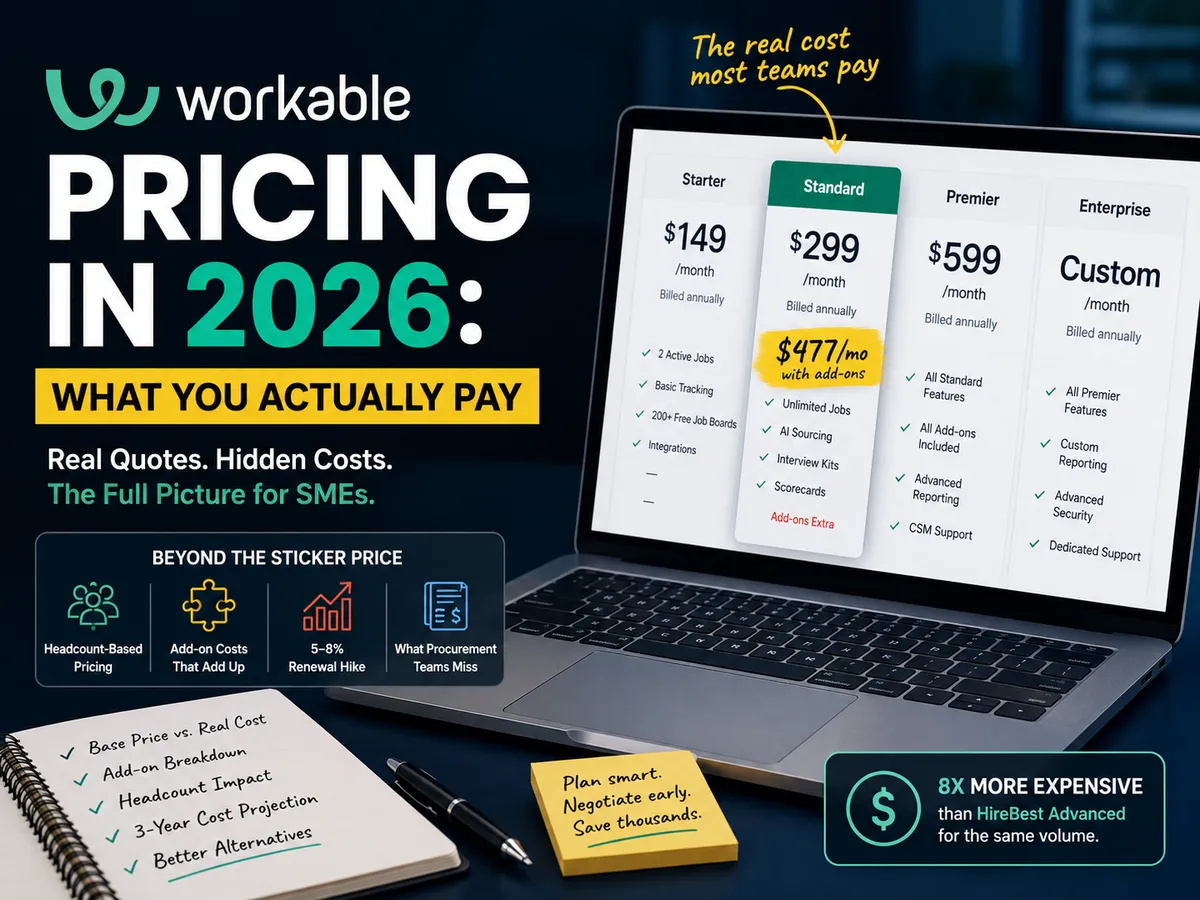
Workable publishes its base prices, which is rare in the ATS world. The catch is that the base price isn't the price most teams pay. Starter opens at $149/month on annual billing, Standard at $299/month, and Premier at $599/month — but once you add Video Interviews, SMS Texting, and account for a few new hires bumping you into a higher headcount band, the real number for a 75-person company on Standard lands closer to $477/month. Annual contracts also default to a 5–8% renewal bump unless you negotiate a cap on day one.
That puts most growing teams in the $5,800–$7,200 range for year one on Standard — about 7x what the HireBest Growth plan costs for screening the same volume of CVs.
The four tiers Workable actually sells
Workable sells Pay-as-you-go, Starter, Standard, and Premier publicly, with a custom-quoted Enterprise tier above 500 employees. The published prices look transparent. What gets buyers is the gap between the published price and the invoice.
Pay-as-you-go is $99 per open role with no monthly commitment. It works for a solo founder hiring once or twice a year. Past four roles in a year the math falls apart and you should be on Starter.
Starter runs $149/month on annual billing ($169 month-to-month), capped at 50 employees. You get two active job slots, basic application tracking, one-click posting to 200+ free boards, and native integrations with BambooHR, Rippling, ADP, and Gusto. What you don't get: AI sourcing, real reporting, Video Interviews, SMS Texting, Assessments, or the onboarding module. Most teams that pick Starter expecting it to last a year end up on Standard inside a quarter — the two-slot cap is the part that bites.
Standard opens at $299/month on annual billing and is the tier Workable's sales team pushes hardest. You get unlimited job slots, AI sourcing across their 400M+ candidate database, structured interview kits, and team scorecards. What you don't get bundled: Video Interviews ($99–109/mo add-on), SMS Texting ($79–89/mo add-on), Assessments ($59/mo add-on), and Performance Reviews. Stack two of those on and you're at $477/month. Stack four and you're at $595/month — basically Premier money.
Premier is $599/month on annual billing and bundles every premium tool by default. You also get unlimited custom reporting, real approval workflows, and a dedicated CSM. For mid-market teams that need three or more add-ons, Premier is the cheaper plan even though the sticker says otherwise.
The headcount problem
Workable's pricing model isn't per-seat like Greenhouse or Lever. It's per-headcount. Every tier is priced against your total company employee count, not how many recruiters use the tool. A 50-person company with one recruiter and a 200-person company with one recruiter pay very different amounts for identical usage.
For SMEs in growth mode, this creates budget unpredictability that's worth modelling before you sign. A team at 45 employees on Standard pays the base $299/month. The moment they hire to 51, they shift into the next headcount band and the bill climbs. The recruiter using the tool didn't change. The amount of recruiting work didn't change. The invoice did.
The hidden cost most procurement teams miss: Workable typically opens renewal negotiations with a 5–8% increase. If you don't negotiate a price cap into the original contract, that compounds quietly. A $299/month Standard plan signed in 2026 lands closer to $336/month by 2028 even before you add a single new employee.
The add-on stack nobody walks you through
The single biggest gap between Workable's brochure and Workable's invoice is the add-on stack. Video Interviews adds $99–109/month for one-way and live candidate interviews at scale. SMS Texting adds $79–89/month and drives 98% candidate response rates — about 60x faster than email. Assessments adds $59/month for skills tests on technical and operational roles. Performance Reviews — goal tracking and 360 feedback after hire — is quoted separately.
A team using Video Interviews and SMS Texting (the most common combo for mid-market hiring) adds $178/month on top of Standard's $299. That's where the $477/month real-world cost comes from. Add Assessments on top and you're at $536/month — within $63 of Premier, which would have given you all three add-ons plus advanced reporting and a CSM for one flat price.
The math gets uglier on multi-year contracts. Three years on Standard with Video + SMS at a 6% annual renewal hike looks like this: Year 1 is $3,588 base plus $2,256 in add-ons for a total of $5,844. Year 2 picks up a 6% renewal bump plus 10 new hires shifting you into the next headcount band — $6,580. Year 3 lands at roughly $7,200 after another 6% bump and steady headcount creep. Three-year contract value: roughly $19,624. About triple what the homepage quoted you for year one.
The alternative math
The HireBest Growth plan costs $840 per year billed annually ($99/month). It covers bulk CV screening with AI scoring and JD-cited reasoning, 3 users, custom company branding, screening history per JD, and bulk uploads of 100+ PDFs. That's a $5,004 per year difference against a real-world Standard contract on Workable — before renewal hikes, before headcount creep, before you stack a third add-on.
The honest framing: Workable and HireBest don't do exactly the same thing. Workable is a full ATS with pipelines, careers pages, and onboarding modules. HireBest is the screening layer — the part that takes a stack of 100 CVs and tells you which 10 to actually interview. Most SMEs we talk to don't need the full ATS suite. They need the screening to stop eating 8 hours a week. That's where the cost gap shows up.
If you already have a lightweight HRIS or your team is small enough that pipelines live in a shared spreadsheet, HireBest replaces the part of Workable that actually matters — the candidate-evaluation work — for a fraction of the cost. If you need the full ATS workflow, Workable Standard is a reasonable buy, but go in with eyes open on the add-on stack and the renewal cap.
Who Workable actually fits
Workable is the right call if you're hiring 10+ roles a year, sit between 20 and 200 employees, want recruiting-grade features without Greenhouse-grade pricing, and your team already runs interviews through a structured pipeline. It's overkill for a founder hiring once a quarter, and it'll feel underpowered the moment you cross into venture-backed scale with 100+ open reqs and a dedicated recruiting team.
Buy Workable if you're hiring across multiple departments at the same time, your recruiters need collaboration features like comments and structured scorecards, you want a branded careers page that doesn't look like 2014, and you're willing to negotiate a renewal cap before signing the annual contract.
Look elsewhere if your bottleneck is candidate evaluation rather than pipeline management, you hire fewer than 5 roles a year (pay-per-job or a lean tool wins on cost), you need deep DEI reporting and approval chains (Greenhouse fits better), or your hiring volume is unpredictable and headcount-band jumps would blow your budget.
Most SMEs we talk to fall into the "candidate evaluation is the actual bottleneck" camp. That's where a lean AI screener saves more time and money than upgrading to Premier ever will.
How to negotiate Workable
A few things buyers consistently leave on the table.
1. Price cap on renewal. Workable's default 5–8% bump is negotiable. Ask for a 0% cap on the first renewal and 3% maximum thereafter. Most reps will agree if you push.
2. Add-on discounts. Bundle Video Interviews and SMS Texting into the base contract instead of paying month-to-month rates. Workable will often discount the bundle by 15–20%.
3. Headcount band protection. If you're growing fast, ask for a fixed price through a specific headcount range — for example, locked in up to 100 employees regardless of when you cross the next band.
4. Annual vs month-to-month math. The 20% annual discount only makes sense if you're confident you'll still use the tool 12 months later. If you're early in your hiring cadence, the month-to-month premium is worth the flexibility.
The buyers who do well on Workable don't pay the brochure price. They pay 15–25% under it because they asked.
Frequently asked questions
How much does Workable cost?
Workable costs $149/month for Starter (annual billing, up to 50 employees), $299/month for Standard, and $599/month for Premier, with pay-as-you-go at $99 per open role. Prices rise with company headcount, and add-ons like Video Interviews ($99–109/month) and SMS Texting ($79–89/month) are extra — so a typical Standard team really pays around $477/month, or about $5,800 in year one.
Does Workable offer a free trial?
Yes. You get a 15-day free trial on Starter and Standard with no credit card up front. You can post one live job, collect applications, and test the integrations during that window. Premier and Enterprise both gate behind a demo and a custom quote.
Is Workable cheaper than Greenhouse?
For small and mid-market teams, dramatically so. Greenhouse Essential opens at $5,000–$6,500 per year, and that's before per-seat fees push the year-one total to $9,000–$14,000. Workable Standard with realistic add-ons lands at $5,844 for year one — still pricier than HireBest Growth at $840/year, but a fraction of Greenhouse.
Is Workable's pricing actually transparent?
Mostly yes. Workable publishes base monthly prices for Starter, Standard, and Premier without forcing you through a sales gate. The fuzzy parts are exact headcount-tier breakpoints above 50 employees, Enterprise quotes, and renewal pricing. Add-on prices are published but rarely surfaced during demos.
What add-ons are included in the Premier plan?
Premier bundles Video Interviews, SMS Texting, Assessments, and the advanced reporting suite at no extra cost. The crossover happens when a Standard buyer hits three add-ons. After that, Premier wins on per-month cost.
Can I cancel Workable mid-contract?
Annual contracts lock you in for the full term and typically don't refund if you bail early. Month-to-month is cancellable anytime but costs about 20% more. The clean exit is to put a contract review on the calendar 60 days before renewal and renegotiate from there.
Related
Try it
Start screening for free
HireBest scores every CV against your JD with written reasoning — free to try.
Try HireBest free