
50 Software Engineer Interview Questions (2026 Guide with What to Listen For)
Free list of 50 software engineer interview questions — technical, behavioral, system design, situational. Includes what to listen for in each answer. Generate more with AI.
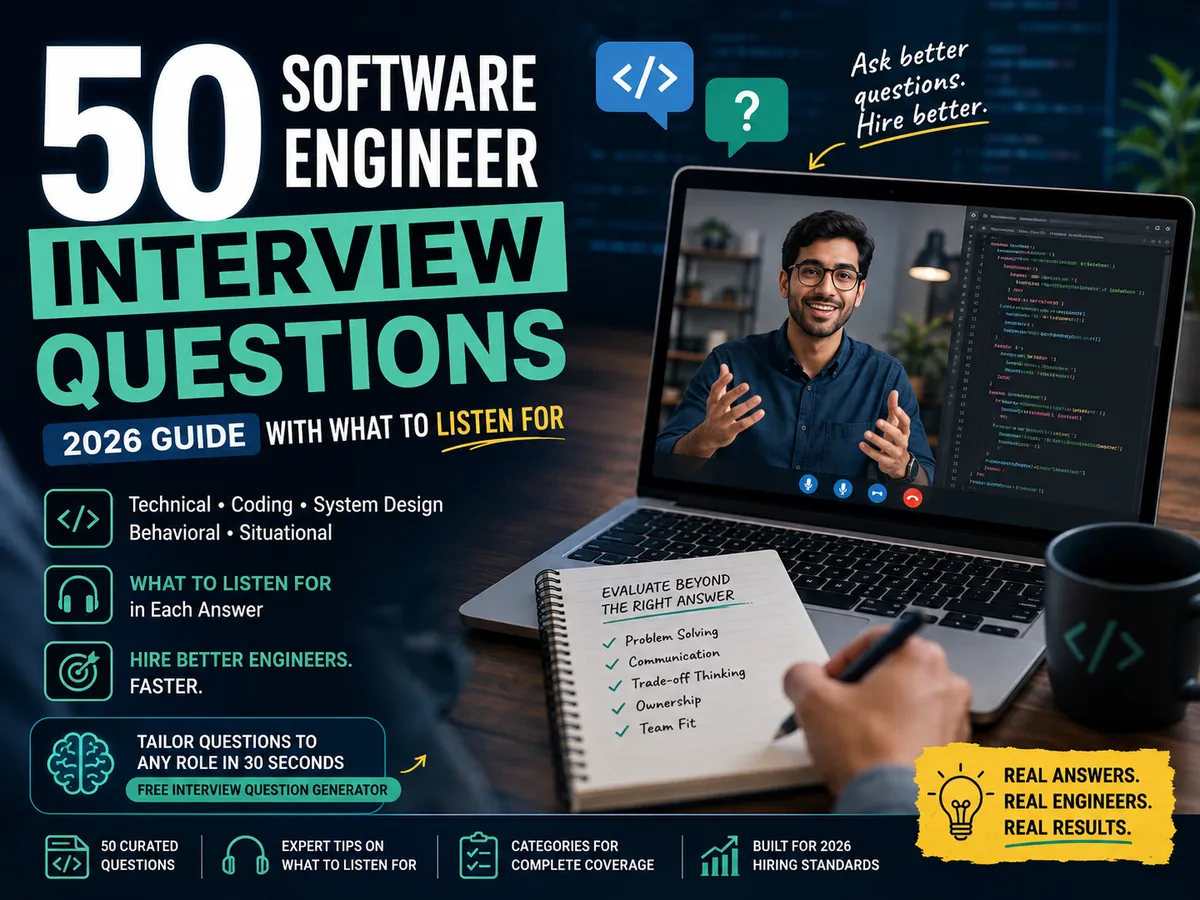
Short answer: The best software engineer interview questions mix five categories — technical fundamentals, coding, system design (mid-level and up), behavioral, and motivation. Ask 5–7 per round with strong follow-ups. Don't grade the textbook answer; listen for how the candidate reasons through trade-offs, asks clarifying questions, and handles being wrong.
Hiring a strong software engineer in 2026 isn't about finding someone who can solve LeetCode hards in 12 minutes. It's about finding someone who can ship working code, debug under pressure, communicate trade-offs to non-engineers, and not break the team culture. This guide gives you 50 questions across five categories, plus exactly what to listen for in each answer so you can spot the difference between a memorized response and real engineering judgment.
Use these as your starting point. If you want questions tailored to your specific JD — Senior Backend on Go, Junior Frontend on React, Mid-level DevOps on AWS — generate them in 30 seconds with HireBest's free Interview Question Generator.
How to use this guide
Don't ask all 50. A good engineering interview loop is 5–7 well-chosen questions across the categories below, with strong follow-ups that probe whether the candidate actually understands what they're saying. Pick 1–2 technical fundamentals as warm-ups, 1–2 coding or problem-solving questions, 1 system design question for mid+ roles, 2–3 behavioral questions, and 1 culture or motivation question.
For each answer, listen less for the "right" textbook response and more for how the candidate reasons through trade-offs, asks clarifying questions, and handles being wrong.
Hiring for a specific specialty? Go deeper with our backend developer interview questions, frontend developer interview questions, and 30 behavioral interview questions for software engineers. Still sorting through applications? Start with how to screen software engineer resumes.
Technical fundamentals (questions 1–10)
These are warm-ups. Strong candidates should answer them confidently and concisely. Weak ones either over-explain or memorize without understanding.
1. What's the difference between a process and a thread? Listen for: memory sharing (threads share, processes don't), context switch cost, when they'd choose one over the other. A strong answer mentions concurrency model trade-offs.
2. Explain what happens when you type a URL into a browser. Listen for: DNS resolution → TCP handshake → TLS → HTTP request → server → response → render. Bonus points for mentioning caching layers, CDNs, or DNS prefetching.
3. What's the difference between SQL and NoSQL? Listen for: schema-on-write vs schema-on-read, consistency vs scalability, use cases. Red flag: "NoSQL is faster." That's not the trade-off.
4. Explain Big O notation in plain English. Listen for: growth rate as input size grows, not exact runtime. Strong candidates explain why O(log n) matters at scale and give a real example.
5. What is REST and how is it different from GraphQL? Listen for: over-fetching/under-fetching, single endpoint vs multiple, when each is the right pick. Watch for candidates who name-drop without understanding.
6. What's the difference between authentication and authorization? Listen for: "who you are" vs "what you can do." Bonus: examples of OAuth, JWT, RBAC.
7. Explain how garbage collection works in your primary language. Listen for: generational hypothesis, mark-and-sweep, when GC pauses matter (latency-sensitive systems). Specifics by language are fine.
8. What is a deadlock and how do you prevent it? Listen for: the four conditions (mutual exclusion, hold and wait, no preemption, circular wait) and at least one prevention strategy.
9. What are the SOLID principles? Listen for: not just naming them — listen for an example of when they applied (or violated) one. Memorized definitions don't count.
10. Explain idempotency. Listen for: same operation, same result regardless of how many times it's called. Bonus: real example from API design or payments.
Coding and problem-solving (questions 11–20)
These are the questions where you actually watch candidates think. The answer matters less than the process.
11. Reverse a linked list. Listen for: clean iterative or recursive solution, edge cases (empty list, single node), and whether they can explain it without writing code first.
12. Find the first non-repeating character in a string. Listen for: hash map approach (O(n)) vs nested loop (O(n²)). Strong candidates discuss the trade-off.
13. Given a sorted array, find two numbers that sum to a target. Listen for: two-pointer approach. If they jump to brute force without considering the sorted hint, that's a small flag.
14. Detect a cycle in a linked list. Listen for: Floyd's tortoise and hare. Memorized? Probably. But ask them to explain why it works.
15. Implement a basic LRU cache. Listen for: hash map + doubly linked list. This is a classic, so it's less about novelty and more about clean implementation.
16. How would you find the kth largest element in an unsorted array? Listen for: heap approach (O(n log k)) or quickselect (O(n) average). Sorting first works but loses points at scale.
17. Walk me through how you'd debug a production bug you can't reproduce locally. Listen for: hypothesis-driven debugging, logs, observability tools, narrowing scope, willingness to bring in others.
18. You wrote code that passes all tests but a customer reports a bug. What now? Listen for: reproducing the bug, writing a failing test first, then fixing. Watch for candidates who blame the customer.
19. How do you decide when to refactor vs rewrite? Listen for: cost-benefit reasoning, test coverage as a prerequisite, awareness of risk. "Rewrite everything" is a red flag.
20. Explain a recent technical decision you made and what trade-offs you considered. Listen for: specific context, named alternatives, why they picked what they picked. Vague answers mean the candidate didn't actually own the decision.
System design (questions 21–30)
For mid-level and above. Strong candidates ask clarifying questions before drawing anything. Weak ones jump straight to a database.
21. Design a URL shortener like bit.ly. Listen for: base62 encoding, hash strategy, database choice, scaling reads vs writes, caching layer.
22. Design a rate limiter. Listen for: token bucket vs sliding window, where to enforce (gateway vs service), distributed coordination.
23. Design a notification system that sends 1M push notifications per hour. Listen for: queue-based architecture, retries, idempotency, fanout patterns, monitoring.
24. How would you design Twitter's home timeline? Listen for: fanout-on-write vs fanout-on-read, hybrid approach for celebrity accounts, caching trade-offs.
25. Walk me through how you'd design a chat application. Listen for: websockets vs polling, message persistence, read receipts, scaling to millions of concurrent users.
26. How do you handle data consistency in a distributed system? Listen for: CAP theorem awareness, eventual vs strong consistency, when they'd accept each. Avoid candidates who claim "always strong consistency."
27. Design an autocomplete system. Listen for: trie data structure, caching popular prefixes, real-time updates, personalization layer.
28. How would you scale a database that's hitting write limits? Listen for: read replicas, sharding strategy, partitioning keys, when to introduce a queue.
29. Design a file storage service like Dropbox. Listen for: chunking, deduplication, sync conflicts, offline support, metadata vs blob separation.
30. Walk me through your approach to a system design question you've never seen before. Listen for: clarify requirements → estimate scale → high-level components → bottlenecks → iterate. The methodology is the answer.
Behavioral (questions 31–40)
Use the STAR method (Situation, Task, Action, Result) as your listening framework. Vague answers are the biggest tell.
31. Tell me about a time you disagreed with a technical decision made by your team. Listen for: data-driven persuasion, professional handling, willingness to disagree and commit. Red flag: villain stories where the candidate is always right.
32. Describe a situation where you had to work with a difficult colleague. Listen for: empathy, conflict resolution, focus on shared goals. Watch for blame language.
33. Tell me about a time you shipped something that broke production. Listen for: ownership, what they learned, what process changed afterward. Candidates who never broke prod either lied or didn't ship much.
34. Walk me through a project you're proud of. Listen for: their specific contribution, real impact, what they'd do differently now.
35. Describe a time you had to learn a new technology quickly to ship a feature. Listen for: learning approach, where they got stuck, how they validated they'd learned it correctly.
36. Tell me about a time you mentored a junior engineer. Listen for: concrete examples, what the junior actually learned, patience under pressure. Senior+ role signal.
37. Describe a time you missed a deadline. What happened? Listen for: root cause analysis, what they communicated and when, what they changed afterward.
38. Tell me about a time you received critical feedback. Listen for: specific feedback, how they responded emotionally, what they actually changed. Defensive answers are a flag.
39. Walk me through a time you had to make a decision with incomplete information. Listen for: trade-off reasoning, stakeholder communication, comfort with reversibility ("if we're wrong, here's how we'd back out").
40. Describe your biggest technical mistake. What did you learn? Listen for: specificity, accountability, behavioral change after. "No big mistakes" means they're not telling you about them.
Culture, growth, and motivation (questions 41–50)
These reveal whether the candidate actually wants this job, or whether they're shopping for the next offer.
41. Why do you want to work here specifically? Listen for: specific knowledge of your product, team, or mission. Generic answers ("you're growing fast and seem cool") are a soft no.
42. What kind of engineering culture do you do your best work in? Listen for: alignment with how your team actually works, not aspirational answers. Mismatch here costs you in month three.
43. Where do you want to be in three years? Listen for: ambition that fits the role, not over- or under-shooting. A senior who wants to be CTO in 18 months isn't going to stay.
44. How do you stay current with the field? Listen for: specific newsletters, communities, side projects, books. "I read Hacker News" is the bare minimum.
45. Tell me about a side project or open-source contribution. Listen for: genuine curiosity, not portfolio padding. Optional but useful signal.
46. What's the hardest engineering problem you've worked on? Listen for: technical depth, what made it hard, how they decomposed it. Watch for problems they didn't actually own.
47. How do you handle technical debt? Listen for: incremental refactoring, paying it down inside feature work, when to escalate. "Tech debt is bad" is not an answer.
48. What questions do you have for us? Listen for: thoughtful questions about team dynamics, the role, technical decisions. No questions is a strong negative.
49. What's a strong opinion you hold about software engineering that most engineers disagree with? Listen for: actual conviction, reasoning, willingness to be wrong. Tests for independent thinking and intellectual honesty.
50. Why are you leaving your current role? Listen for: honest reasons, no blame language, alignment with what your role actually offers. Repeated short tenures need a follow-up.
How to score a candidate across these questions
A good rubric uses 1–4 ratings across five dimensions: technical depth (do they understand the fundamentals at the level the role needs?), problem-solving (can they break down ambiguous problems and reason about trade-offs?), communication (can they explain technical concepts to someone with less context?), ownership (do they take accountability for outcomes, or deflect to others?), and culture fit (will they thrive in how your team actually operates?).
Calibrate with another interviewer after every loop. A candidate who scores 4/4 on technical but 2/4 on communication is a different hire than a 3/3 across the board — and the right call depends on what your team needs right now.
Speed up screening with HireBest
Reading 100 CVs to find five candidates worth interviewing usually takes a full day. HireBest does it in 38 seconds — every CV is scored against your JD with written reasoning, missing skills surfaced, and interview questions auto-generated for the candidates you want to talk to.
No credit card. Bulk upload up to 200 CVs at once. Try HireBest free or see transparent pricing from $49/month.
Frequently asked questions
What questions should you ask a software engineer in an interview?
Ask a mix of five types: technical fundamentals ("What happens when you type a URL into a browser?"), a practical coding or debugging problem, a system design question for mid-level and senior roles, behavioral questions about real past situations ("Tell me about a time you broke production"), and one question about motivation. The 50 questions above cover all five, with what to listen for in each answer.
How many questions should a software engineer interview include?
Aim for 5–7 well-chosen questions per round, with strong follow-ups, across a 2–3 round loop. Trying to cover 15 questions in one round produces shallow signal on all of them. Depth over breadth.
Should I ask LeetCode-style coding questions in 2026?
Only if the role actually requires that skill day-to-day. For most product engineering roles, system design and debugging questions predict on-the-job performance better than algorithmic puzzles. For competitive trading firms or core infra, hard coding rounds still make sense.
How do I tell if a candidate memorized their answer?
Ask a follow-up that requires them to apply the concept somewhere new. Memorized candidates handle the canonical question well but stumble on adjacent variants. Real understanding survives the follow-up.
What's the best way to standardize interviews across multiple interviewers?
Use a scorecard with 4–5 dimensions and a 1–4 scale, calibrate weekly, and have every interviewer write up notes within 24 hours. Inconsistent rubrics produce inconsistent hires.
Can AI generate interview questions tailored to a specific JD?
Yes — HireBest's Interview Question Generator takes any job description and produces role-specific behavioral, technical, and situational questions in under a minute. Free to try.
Related
Try it
Start screening for free
HireBest scores every CV against your JD with written reasoning — free to try.
Try HireBest free